
How is change made and how can you help
History is often driven by moments of undeniable courage, and the fight for accessibility is no exception. One piece of history seldom taught to students is The Capitol Crawl. On March 12, 1990, disability rights activists gathered at Capitol Hill and pulled themselves up its eighty-three marble steps by their arms in the pivotal battle for the Americans with Disabilities Act of 1990. The bill had been in legislative limbo for months despite support from then-President George H.W. Bush. It was this historic protest, staged by over a thousand activists, that finally compelled Congress to act.
Unsung Heroes of the ADA
Although the legislation has its criticisms regarding its effectiveness, the fight for its passage can serve as a key lesson in advocacy. Activists on the climb were of diverse backgrounds. One famous young advocate who took to Congress that day was Jennifer Keelan-Chaffins, an 8-year-old girl with cerebral palsy. She had been diagnosed when she was two, causing her to be excluded from a proper education as she was shifted to separate classes.
That blatant discrimination pushed her into the world of advocacy and Jennifer’s participation in the historic ADA protest. It was when Jennifer was photographed on the steps of the U.S. Capitol that she became a key argument for the passage of the ADA. Today, she continues to fight for disability rights as an educator and co-author of the children’s book All the Way to the Top.

Another key advocate, Justin Dart Jr., teaches us that advocacy has to be a team effort. Dart is often considered the “Father” of the ADA. After becoming a wheelchair user due to an infection of polio, he was enlightened with a new perspective on exclusion and discrimination that had not been central to him during his privileged early childhood. As chair of the Congressional Task Force on the Rights and Empowerment of Americans with Disabilities, he and his wife Yoshiko traveled to all fifty states—largely at their own expense—to gather testimony, support, and evidence for the necessity of the ADA. His team collected records that were compiled into the Discrimination Diaries. Using the collection, they inspired the Americans with Disabilities Act.

A report from the World Health Organization estimates that roughly 1.3 billion individuals are disabled. The number can be hard to believe if the average person almost always first pictures a person in a wheelchair. For the vast majority of people who are disabled, others around them will not be able to tell by looking–it's called invisible disability. One key advocate who brings this invisible diversity was Tony Coelho. Living with epilepsy barred Coelho from becoming a priest, but it would eventually lead him to Washington. Facing discrimination firsthand, Coelho became a congressperson and primary author of the ADA. His succinct writing and advocacy garnered bipartisan support for the legislation. Like Magical Bridge, Tony Coelho continued to battle for the world’s largest minority as he pushed for both the U.N. Convention on the Rights of Persons with Disabilities and the establishment of the Office of Disability Employment Policy.
That said, the ADA is only the first step in the fight for truly universal design. It still misses the mark on many key issues, including playgrounds. Since its creation, the law has been attacked in several Supreme Court rulings that have narrowed the definition of what qualifies as a disability. The constant challenges show the battle for inclusion is not even close to over. Legal protections like the ADA lay the groundwork for inclusion, but true inclusion is realized when it can be localized to our communities. That is where Magical Bridge comes in, and where your voice makes all the difference.
Bringing Inclusion to Your Neighborhood
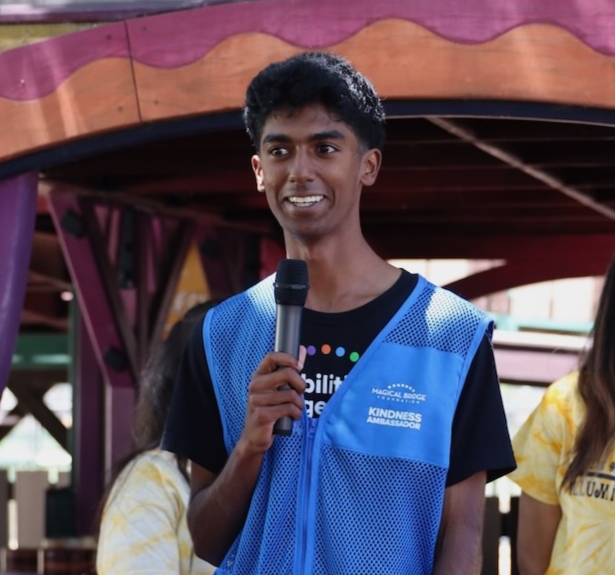
Magical Bridge offers several ways to be a part of the mission. One important step you can take at any ability is to sign up as a Kindness Ambassador. This volunteer program empowers you to connect directly with your local community. Our parks regularly host Community Partner Days, live music, performances, STEAM activities, and more. Because our parks thrive on community support, showing up to volunteer is often the very first step in your advocacy journey.
After you’ve joined as a Kindness Ambassador and experienced the movement firsthand, you may want to bring a Magical Bridge Park to your community. Building a park is not easy! From the exhaustive design process to messy politics and bureaucracy, the journey won’t be simple. Don’t let that deter you from getting started and seeing how far you can go (Magical Bridge will help you!).
How to get started in your community:
1. Research and Connect with Community Leaders
City Government: Attend city hall meetings and reach out to council members, mayors, and urban planning officials.
School Boards: Many playgrounds are located at schools rather than public parks. Reach out to principals, teachers, and school board representatives.
Magical Tip: Copy play4all@magicalbridge.org on your emails so the Magical Bridge team can support your outreach.
2. Participate in Upcoming Park Projects
Check your city’s public notice boards or website for upcoming park renovations/projects.
Attend public input sessions at city hall meetings to advocate for inclusive, universal design right from the planning stages.
Every inclusive park begins with a single email, conversation, or community meeting. Take the first step today. Let's build spaces where everyone belongs.
Works Cited
About the author
Gautham Ramkumar is a youth advocate and researcher specializing in neuro-inclusive education and community accessibility. As a student at Mission San Jose High School, he serves as a Kindness Ambassador for the Magical Bridge Foundation and is the founder of Cocoon Corner, where he works to integrate neurodiversity education into public schools. His diverse advocacy portfolio includes leading NeuroGuidance and spearheading affordable housing initiatives for Rebuild the Bay, alongside collaborations with the Stanford Neurodiversity Project and Friends of Children with Special Needs (FCSN). Gautham is dedicated to bridging the gap between academic research and community-led inclusion to ensure that both public spaces and education are accessible for all. Outside of his advocacy work, Gautham enjoys backpacking, walking his dog Suki, and studying Biology.


Comments